
Dee Robinson – A Spirited Conversation
Dee Robinson didn’t set out to change the bourbon industry; she just wanted to make something beautiful and start a few necessary arguments along the way.
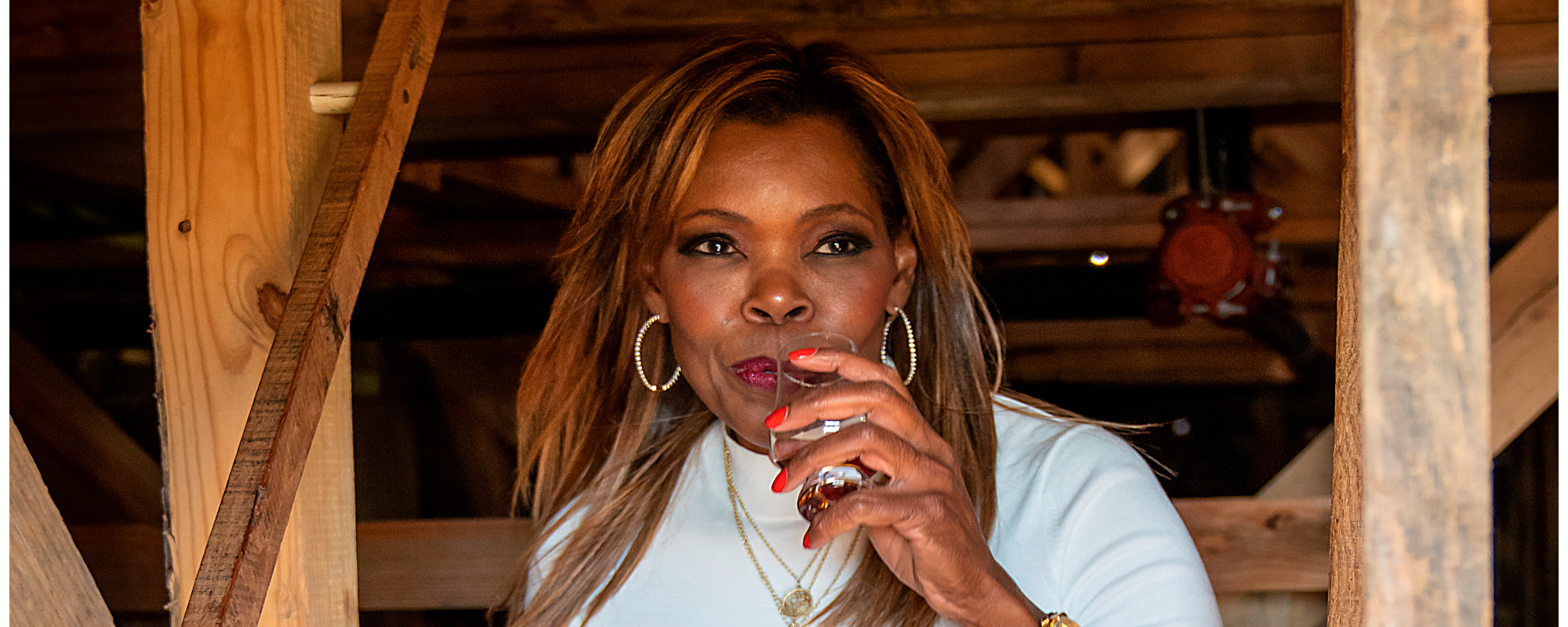
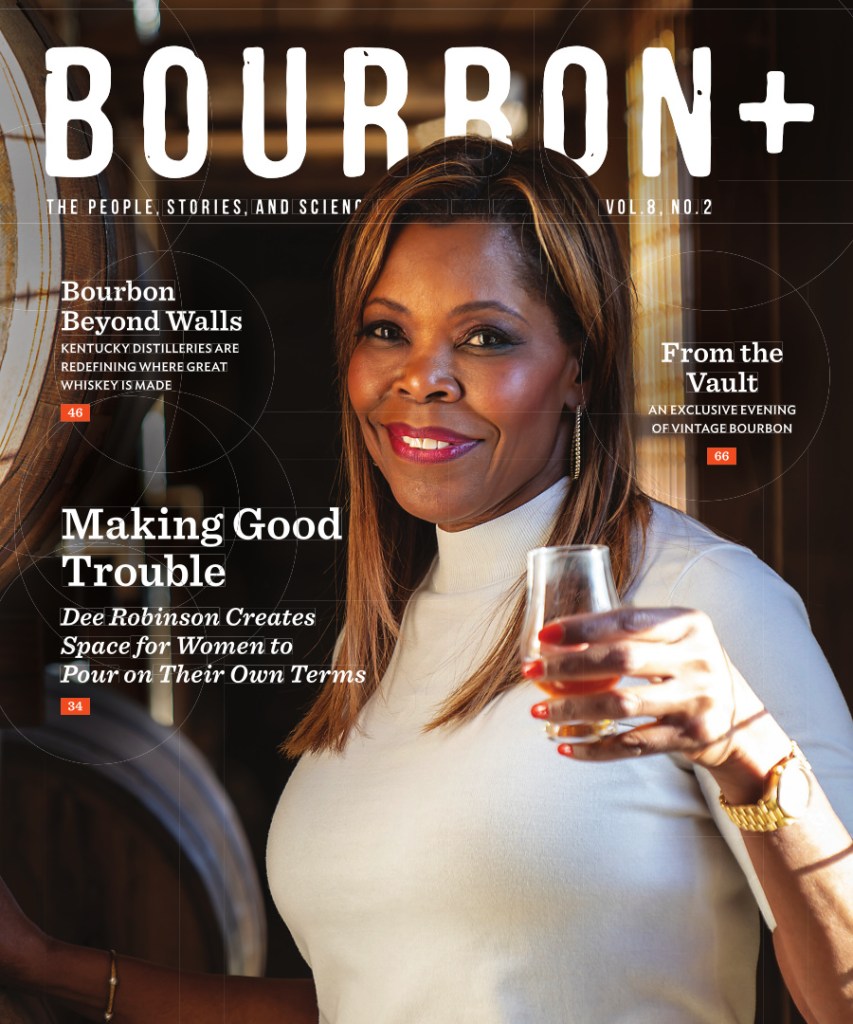
She sits across from the camera in a soft cream sweater, bejeweled glasses catching the light from a Chicago window where the temperature has plunged to negative 30. Dee Robinson looks like what she is, a polished professional, a woman who has spent decades meeting in boardrooms and studying balance sheets.
Her expression is calm, but there is something else there, too. A coiled energy joins the particular stillness of someone who has learned that the world will underestimate her and has decided to let it.
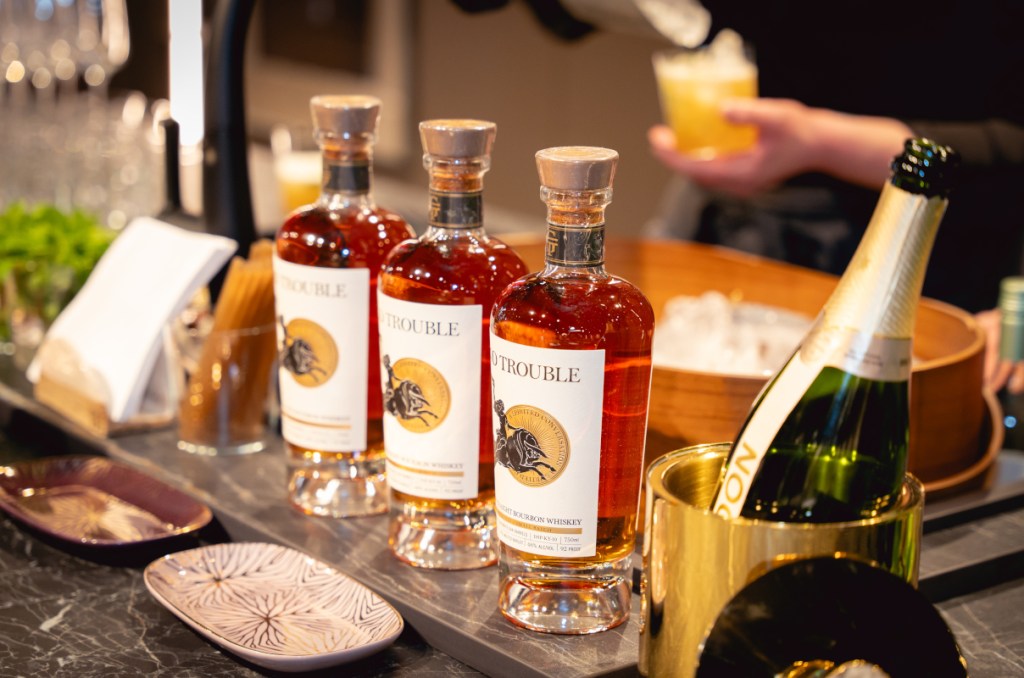
Her bourbon brand tells a different story. Good Trouble Kentucky Straight Bourbon Whiskey has a label featuring a diverse, global representation of Lady Liberty astride a charging bull, representing unity, resilience, and the power of speaking up for justice. The motto embossed in gold reads “A SPIRITED CONVERSATION.”
March is Women’s History Month, and Dee Robinson has certainly earned her place in it.
In its debut year, Good Trouble made a bold entrance onto the spirits scene, earning a Platinum Medal from the Las Vegas Global Spirits Awards and 11 Gold Medals, including “Best Story” from the International Spirits Competition. She has also earned Double Gold at the 2025 TAG Spirits Awards and Gold at the San Francisco World Spirits Competition, the holy grail, as bourbon insiders call it. Forbes listed Good Trouble as one of the best bourbons under $50.
“You can’t be called Good Trouble and be bad,” Robinson says. And there it is. That slight smile, the one that suggests she knows exactly how many people hoped she would fail.
The bourbon industry has a narrative problem, she says. For generations, it has told the same story of only men in rickhouses, men in barrel rooms and men in leather chairs holding cut crystal. The marketing has been masculine, the gatekeeping fierce, and the message unmistakable.
This is not for you.
But narratives can be rewritten, Robinson says. Women now make up 30 percent of bourbon drinkers, a number that’s climbing fast. The market for bourbon is projected to reach $11 billion dollars by 2028, up nearly seven percent since 2024. And increasingly, the women buying bourbon are not content to simply consume it. They want to create it, brand it, and pour it on their own terms.
Robinson understood this before most of the industry did.
THE JOURNEY ON A WINDING PATH
“I talk about us being on a journey,” Robinson says about women in bourbon. “Men start at the baby neat, then a drop of water, then a cube, and finally a cocktail. Women come in the opposite direction. Cocktail first, then they walk up the ladder. Men walk down.”
It’s a simple observation, but it carries revolutionary implications. If women enter bourbon through cocktails, then cocktails aren’t a lesser form of appreciation. They’re a gateway.
“We’re building a cocktail culture,” Robinson says, “because what I love about it is that it creates community when women come together.”
Robinson’s path to bourbon was not direct. Born in Cleveland and raised on the values of hard work, integrity, and giving back that her mother instilled, she built a career that would make most people dizzy. After earning her MBA from Northwestern’s Kellogg School of Management and a degree in economics from the University of Pennsylvania, she worked at Johnson & Johnson and Leo Burnett before founding Robinson Hill, Inc. in 1995. The concessions management firm now operates over 60 airport restaurants and retail stores in partnership with brands like Hudson Group, Ben & Jerry’s, and Potbelly.
She serves on the boards of Accel Entertainment and Wintrust Bank. She’s a trustee of PGA REACH. She’s been named a HistoryMaker, a Chicago United Business Leader of Color, and one of WomenInc.’s Most Influential Corporate Directors. In May 2024, she received an honorary doctorate in human letters from Kentucky Wesleyan College.
And then there’s the bourbon.
“I love bourbon,” she says simply. “The short answer is that I love to drink it. But then there were these magical moments that happened.”
The magic began at a tasting, where the complexity and range of flavors captivated her. Robinson had spent decades in the food business. She knows flavor profiles the way some people know music.
So, she studied craft distilling. She visited distilleries. She asked herself the question she now asks every woman who will listen.
Why not you?
A GOOD NAME
The name came from her mother.
“My mom used to say the only kind of trouble we could get in was good trouble,” Robinson says, “because my older sister got into all the rest.”
But the phrase carries deeper resonance now, echoing the late Congressman John Lewis’s call to get into “good trouble, necessary trouble” in the pursuit of justice and equality.
Good trouble means coming together, speaking your mind, and finding common ground with divergent voices. It means believing that bourbon can be more than a drink, becoming a catalyst for conversation and a tool for connection. Every bottle of Good Trouble features a QR code that links to videos, recipes, and stories. A portion of every sale benefits the Be Good, Do Good Shine Your Light Foundation, which funds community-driven initiatives.
“We’re not a bourbon company,” Robinson says. “We’re a cultural platform that happens to use bourbon to bring us together.”
OLD SCHOOL MEETS NEW SCHOOL
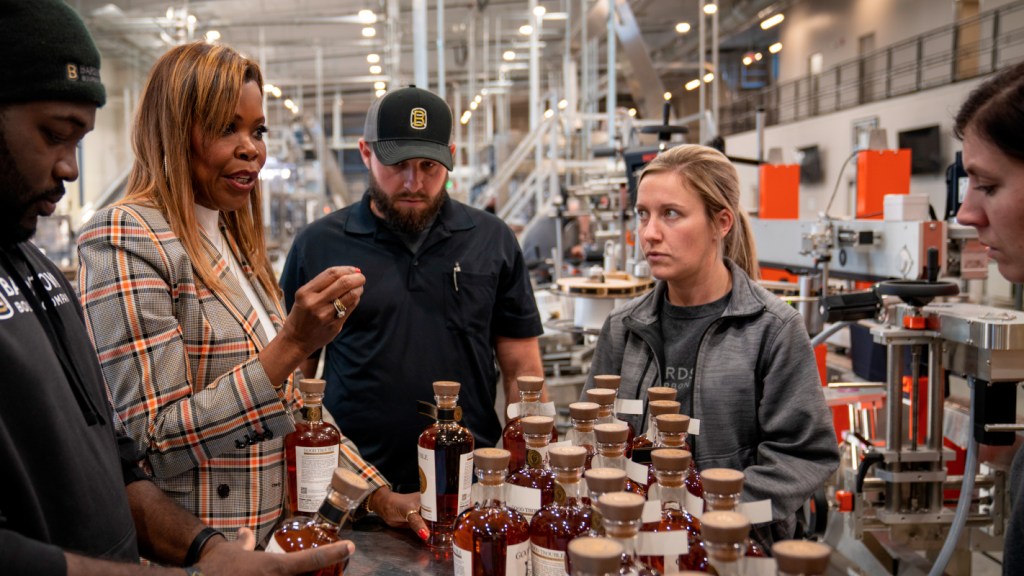
She collaborated with Jacob Call, an eighth-generation master distiller at Green River Distilling Company in Owensboro, Kentucky. The partnership was deliberate because Robinson wanted Kentucky bourbon, aged in the state’s limestone-filtered water and particular climate and steeped in the history of America’s native spirit. But she also wanted something that solved a problem she’d identified in the market. Too many people said they didn’t like bourbon because they didn’t like the burn.
“Sadly, oftentimes that first experience can matter,” she says. “If you were drinking bad bourbon and it had that heat, you swear off it.”
Call kept sending samples. Robinson kept tasting, narrowing it down, and taking bottles to bars and friends until the right profile emerged. The result is 70 percent corn, 21 percent rye, nine percent malted barley, aged more than four years in new charred white oak barrels. It is remarkably smooth. At 46 percent alcohol, it opens with notes of caramel and bakery spices, dried cherry, hazelnut, and vanilla, finishing with hints of spiced nuts and chocolate mint.
“Last night we were at a bar,” Robinson says. “I sent a sample around. The women were like, ‘Man, I would drink this.’ But the best compliment came from a guy who said, ‘You know what, I always thought bourbon was hot. I drink this, it’s really smooth.’”
The journey, however, has not been smooth.
When Robinson began interviewing distilleries and master distillers, there was enthusiasm. An investor even offered money to build. When she shared the name she’d trademarked, she discovered someone had tried to file for her intellectual property, betting that a Black woman couldn’t possibly have secured it first.
“They tried to go in and take the name,” she says. “The only way I knew that was happening was when the application got rejected.”
There were barrel disputes. Distilleries claimed her allocated inventory wasn’t available. Pricing sometimes quintupled overnight. She spent nearly a year fighting for barrels she’d already negotiated and paid for.
“I could have easily just stopped,” she says. “Said, ‘You know what, I’m done. They told me there’s no barrels and my investment is gone, I’ll go do something else.’”
Instead, she pivoted and refused to accept an outcome that others had decided for her.
“When you have a purpose, when you know what you want to do, you’ll find a way to get around the obstacles,” she says. “The best lesson my mom ever told me is that no one ever said it would be easy. And it’s not.”
FROM DISMISSAL TO DEFERENCE
Now the phone rings differently. People who once dismissed her, delayed her, or tried to take what was hers are calling back.
“They see the brand, they see we’re out there getting awards,” Robinson says. “And I say, ‘Thank you, but no thank you.’“
Good Trouble is now available in 40 states, with distribution expanding. The flagship bourbon ages for at least four years, but Robinson and her team are preparing limited releases of seven-year and 10-year editions. The newest offering, “Trouble in Blues,” is a limited-edition 100-proof bourbon celebrating the storytelling and resilience of blues music, with a portion of proceeds supporting the Chicago Blues Legacy Project. Only around 400 bottles exist, and they’re nearly gone.
THE TRUTH OF GOOD TROUBLE
There is a cocktail called The Truth. Robinson created it because, as she puts it, “the world needs a little more of that.” The recipe is simple. Just two ounces of Good Trouble Bourbon, half a lemon’s worth of juice, three-quarters ounce of maple syrup, and a few dashes of bitters. It’s the kind of drink that starts conversations.
Robinson has written a cocktail book, digital for now, but expanding. She hosts Good Trouble Salons, intimate gatherings where people come together to talk—really talk—about questions that matter.
“People want to connect,” she says. “They want to feel part of something bigger than themselves.”
When asked how women are transforming the bourbon industry, Robinson pauses.
“The most radical thing women did to bourbon was give people permission to enjoy it in their own way,” she says.
It sounds small, but it isn’t. For decades, bourbon had rules that were unwritten but enforced. The rule dictated how to drink it, where to drink it, and who belonged in the conversation. Women are rewriting those rules, not by burning them down but by expanding them. They are insisting that cocktail culture is legitimate, that accessibility isn’t a weakness, and that the door should be open to everyone.
“The category has to stop protecting its past and start inviting the future,” Robinson says. “The bourbon world is learning that inclusion strengthens heritage. It doesn’t dilute it.
“Bourbon didn’t need to be saved; it needed to be expanded.”
MAKE A LOT OF GOOD TROUBLE
Robinson has written two books, Courage by Design and Stirring Up Good Trouble, the latter a cookbook. She speaks frequently, delivering talks with titles like “Why Not You?” that challenge audiences to stop waiting for permission.
“Everything you want is on the other side of fear,” she says. “We hold ourselves back. Most of this is in our minds. We’re telling ourselves that we can’t, or we’re listening to the world. That’s why I say be careful who you share your dreams with. More people will tell you what you can’t do than what you can.”
Robinson is also building a golf course in Georgia, the first private club that is women-centric and designed by a female architect with women in mind. Golf legend Annika Sörenstam, the greatest female golfer ever, is involved. Because of course she is.
Because once you’ve decided to make good trouble, you might as well make a lot of it.
Good Trouble Kentucky Straight Bourbon Whiskey is available in 40 states, at GoodTroubleBourbon.com and select retailers. The limited-edition “Trouble in Blues” 100-proof bourbon is available while supplies last.